How to Storyboard a Short Film, Step by Step
To storyboard a short film, read the script and mark the moments the audience has to see clearly. Break each scene into shots. Give each shot a size and a camera position. Then draw a frame only for the shots that carry the story. The rest stay as words on the shot list. We did this for a sample short made from Poe's "The Fall of the House of Usher." Its shot list has 272 shots. Its storyboard has 58 drawn frames.
What does a storyboard have to do?
A storyboard is a row of small pictures showing what the camera will see. It is not art. It is a plan the crew holds on the day.
The test for every frame is simple. Can the camera operator look at it and know where to stand? If yes, it works.
If you want to see a whole short done this way first, our storyboard example walks through two scenes of it, shot by shot.
Step 1: How do you read a script for pictures?
We read the whole script once with no pen. Then we read it again and underline anything that is a picture. An object. A door swinging shut.
The Usher script opens on a letter. "Black ink on yellowed paper, so close the pen strokes look like cracks." That line is already a shot. The writer has given us the size. It is an extreme close-up, meaning one small thing fills the frame.
Some lines name no picture. "William has no answer" shows nothing. So we add one: William starts to speak, then looks away.
Step 2: How do you break a scene into shots?
Now we go scene by scene and list the shots. Each one gets a code, a size, an angle and a move. The size says how much of the subject is in frame. The angle says where the camera sits. The move says whether the camera stays still or travels.
This list is the shot list. The storyboard is drawn from it. We go through the columns in how to make a shot list from a script.
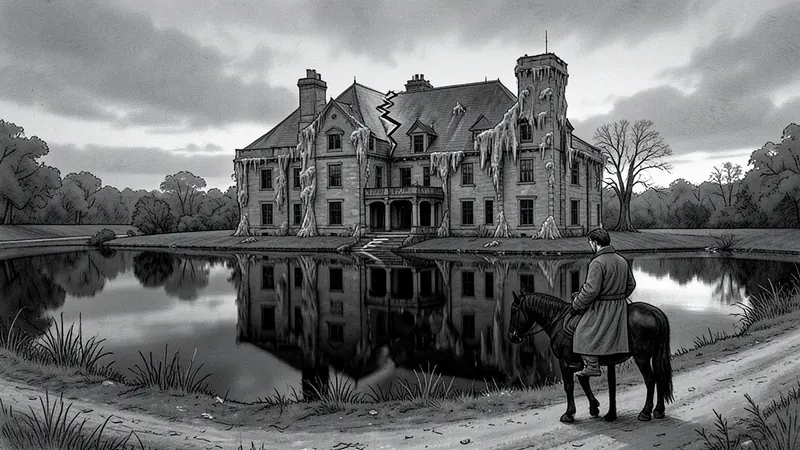
Here are four of scene 2's nine shots. William's horse stops at the edge of the tarn, a small black lake, and he sees the house for the first time.
ECU is extreme close-up. EWS is extreme wide shot, where the land is the subject and the people are tiny in it. WS is wide shot. CU is close-up. A push-in means the camera creeps toward the subject. A tilt means it pivots up or down on the spot.
| Shot | Size | Angle | Move | What we see |
|---|---|---|---|---|
| 2A | ECU | Eye level, profile of the horse's head | Static | The horse's eye fills the frame. In it, a tiny house hangs upside down. |
| 2C | EWS | Eye level, from the lakeshore | Slow push-in | The road ends at the water. Across the tarn, the House of Usher, windows dark. |
| 2G | WS | Eye level, across the water | Slow tilt down | A thin zigzag crack runs down the face of the house and on into the reflection. |
| 2I | CU | Eye level, slightly low, over the horse's neck | Static | William, calm, his hand on the horse's neck. "I know." |
Step 3: Which shots get a drawing?
Not every shot needs a frame. Scene 2 has nine shots and three drawn frames. The crack in 2G is only words. By then 2C has already shown the house from the shore, so the audience knows the picture. A tilt down a crack is easy to say in a line.
Our rule is this. Draw the shot if the picture is hard to say in a sentence. Draw it if getting it wrong would hurt the story. Everything else stays on the shot list.
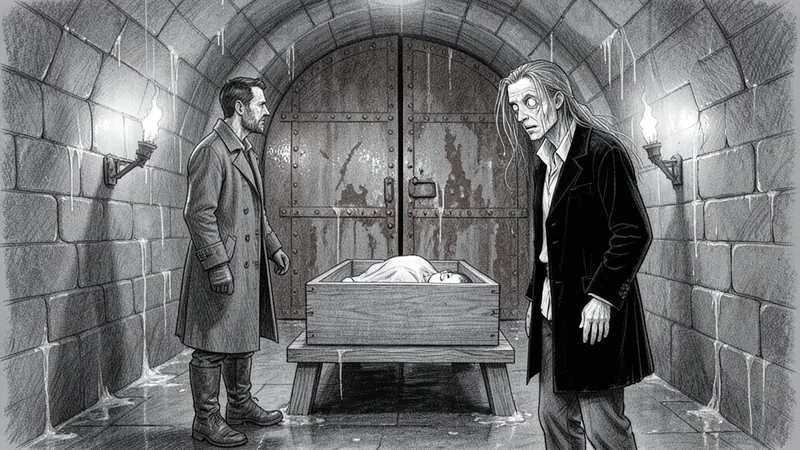
The vault scene shows how this works. Roderick and William lay Roderick's twin sister Madeline in a coffin. 12F is a two-shot, meaning two people share one frame. The men stand on either side of the coffin. Madeline's face lies between them. The point of the shot is that the twins have the same face. A drawing shows that faster than a sentence can. So 12F gets a frame.
Then Roderick walks off to fetch the screws. William is alone with her. 12K is an insert, a tight shot of one detail. Her throat. A flicker. Once, then nothing, then once more. It is a pulse. She is alive.
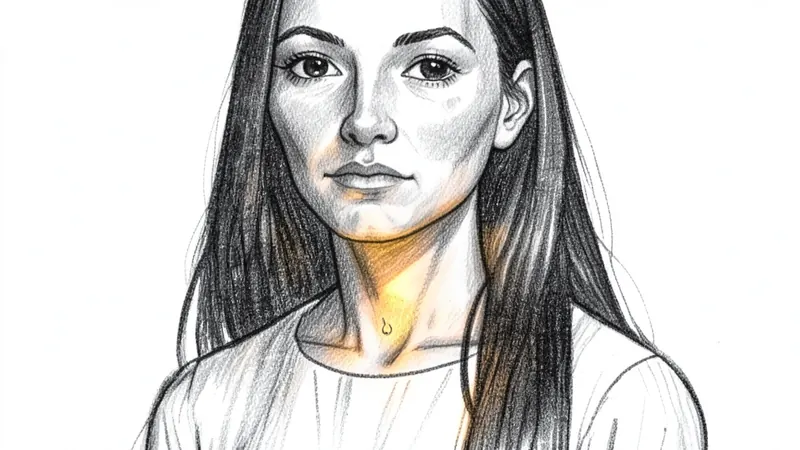
12K gets a drawing because the crew has to know how close is close. 12R, the coffin lid lowering and the screws going in, stays as words. It is high and close on the lid, which one line can say.
Step 4: How do you draw the frames?
Badly, if you have to. A box for the room and a circle for a head. An arrow for the move. The frame for 12K is a neck and some dark. Anyone can draw that.
What matters is where the people are in the box and how big they are.
If even stick figures feel like too much, we wrote up the other ways in how to storyboard when you can't draw.
Step 5: How do you check the boards?
Lay the frames out in order and read them like a comic, with no script next to you. If you lose the story somewhere, a frame is probably missing there.
And check the pairs. In scene 12, shot 12L flashes back to Madeline's flat hand on her bed. Shot 12M shows the same hand with the fingers curled. Flat, then curled, means she moved. That only reads if the audience sees both. So plan them as a pair. Draw both, or keep both as words.
Then stop. A storyboard for a short is done when every scene has its hard shots on paper and the rest are on the list.
Questions
Do I storyboard every scene of a short film?
Every scene goes on the shot list. Only the shots that are hard to describe, or costly to get wrong, get a drawing. In the Usher sample that was 58 drawn frames across 28 scenes.
Should I make the shot list or the storyboard first?
The shot list. A line is faster to write than a frame is to draw. Once the list exists you can see which shots need a picture.
Can I storyboard a short film with no drawing skill?
Yes. Stick figures with a clear frame edge are enough for a crew. The drawing is a note, not a painting.
If you would rather see a finished one first, the sample pack is the whole Usher short laid out this way: 272 shots on the list and 58 pencil frames on the key moments. Pay, upload your own short script, and the same kind of pack comes back by email in about 15 minutes. It is $29 one time, no subscription. See prices.