Storyboard Example: A Short Film Storyboarded Shot by Shot
A storyboard example is a set of drawn frames, one per key moment, with the shot size and a camera note under each one. Below is one we made. We adapted Poe's "The Fall of the House of Usher" into a 10-page short script and ran it through Storyboard with Magic. An AI image model drew the frames in a pencil style. Here are two scenes from it, with the frames and the shot list.
What does a storyboard example actually look like?
Each frame is a picture of what the camera sees. Under it sits a code like 2A, then the shot size, where the camera sits, and whether it moves.
The code is the scene number plus a letter. 2A is the first shot in scene 2, and 2B is the second.
A setup is one place the camera sits. Several shots can share one.
Not every shot gets a drawing. In our Usher pack, 58 of the 272 shots have a drawn frame. The frames go to the moments that are hard to put in words.
The frames show the key moments. The shot list covers every shot. We wrote more on how the two fit together in storyboard vs shot list.
Scene 2: the lake, shot by shot
Here is the scene from the script. William rides up to a black lake. His horse stops dead. Across the water stands the House of Usher, and its reflection hangs upside down in the still water. Then he sees a thin crack running down the face of the house. The horse shies. William steadies it and says, "I know."
Nine shots from five setups. Here is the shot list.
| Shot | Size | Angle | Move | What we see |
|---|---|---|---|---|
| 2A | ECU | Eye level, profile of the horse's head | Static | The horse's eye fills the frame. In it, a tiny house hangs upside down. |
| 2B | CU | Eye level, from the side | Static | The horse's head snaps still. Ears pin forward. |
| 2C | EWS | Eye level, from the lakeshore | Slow push-in | The road ends at the water. William and the horse small in the lower frame, the house across the lake. |
| 2D | MS | Slightly low, across the water | Slow tilt up | Grey stone furred with fungus, rising over rows of dark windows. |
| 2E | WS | Low, at the waterline | Slow tilt down | The reflection fills the frame, the house hanging upside down. |
| 2F | MCU | Eye level, profile | Slow push-in | William leans forward in the saddle, eyes narrowing. |
| 2G | WS | Eye level, across the water | Slow tilt down | A thin zigzag crack runs down the house, and the tilt follows it into the reflection. |
| 2H | TWO-SHOT | Eye level, three-quarter front | Static | The horse throws its head back and shies. William pulls the reins steady. |
| 2I | CU | Eye level, slightly low, over the horse's neck | Static | William, calm, his hand on the horse's neck. "I know." |
The sizes go from tight to wide. ECU is an extreme close-up, one small detail filling the frame. CU is a close-up, often a face. MCU is a medium close-up, head and shoulders. MS is a medium shot. WS is a wide shot, and EWS is an extreme wide, where the place is the picture. A tilt means the camera stays put and turns up or down.
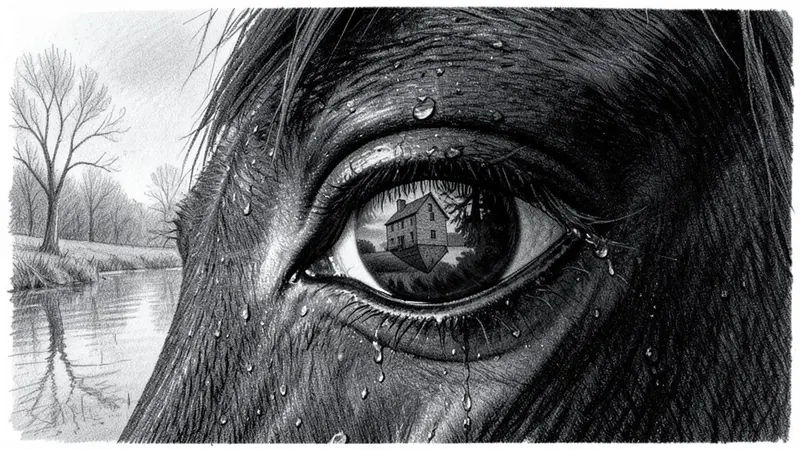
2A is the horse's eye with the house reflected in it. It gets a frame because the idea is hard to say in a line. How big is the eye? How small is the house inside it? The drawing answers both.
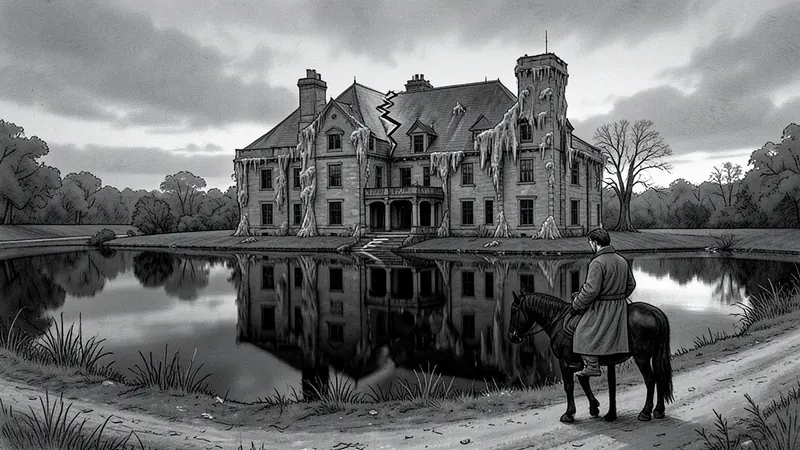
2C tells you where everything is. The lake in front, the house across the water, the rider small at the bottom. A wide that shows where everything is, usually early in a scene, is called an establishing shot.
2E, the reflection, is the third drawn frame. The other six stay as text. A man leaning forward in a saddle, 2F, needs no drawing. One line says it.
Scene 12: the vault, where the frame matters most
Scene 12 is where William sees that Madeline is still alive. It has 22 shots from six setups. Eight of them are inserts.
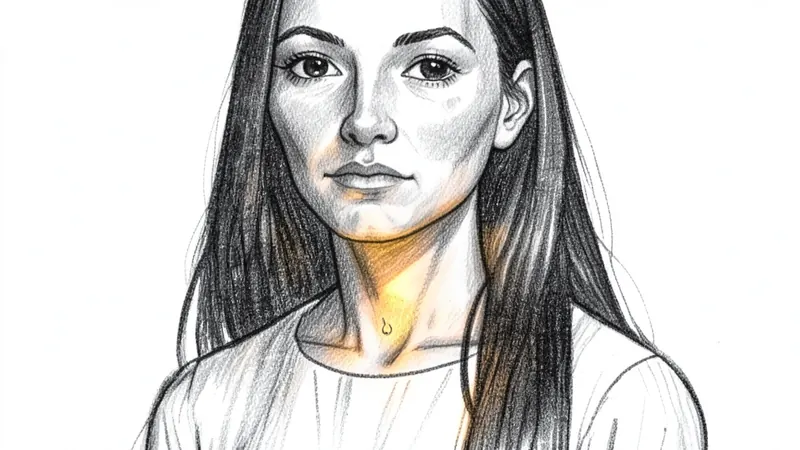
12K is the turn of the whole film. The flicker at Madeline's throat is a pulse. She is alive, and only William sees it. The script line is almost as short as the shot: "At her throat, under the thin skin: a flicker. Once. Then nothing. Then once more."
Then 12L flashes back to the bedchamber, her right hand lying open and flat. 12M is the same hand in the vault, and the fingers are curled. Flat, then curled, means she moved. Neither shot has a drawing. A close shot of a hand is easy to describe in words.
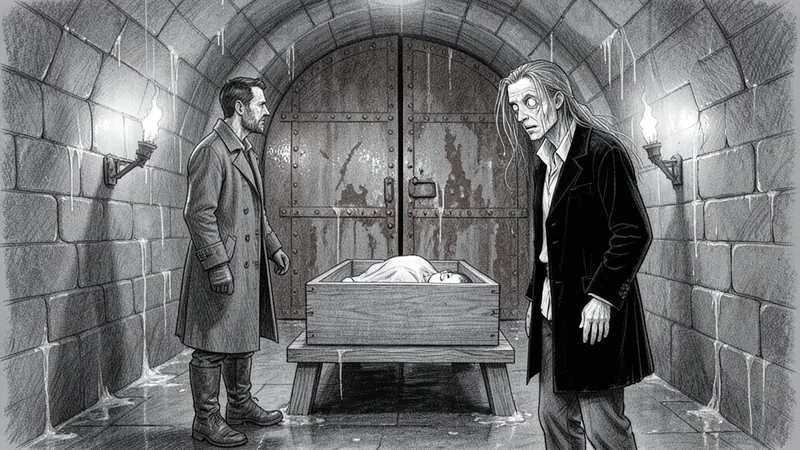
12F is a two-shot, both men in profile across the coffin, Madeline's face between them. Static. A two-shot means two people in one frame. Madeline is Roderick's twin, and the note says "the same face, exactly the same." That one gets a drawing for the staging: who stands where around the coffin.
What should you copy from this example?
Draw the shots where the picture is the point. 2A, because the house in the eye is the idea. 12K, because the flicker is the story. Leave the dialogue singles as text in the shot list. A single is a shot with one person in it.
Write the move under every frame, even "static". Otherwise the crew guesses.
Keep the code. The assistant director and the editor both use 12K. Our shot list template shows the columns we keep for every shot.
And if you cannot draw, you can still make this. An AI image model drew these frames from short scene descriptions. Some come out rough. The pack planned 60 frames. 58 came out as drawings. The image model's safety filter stopped the other 2, so they are left out. The shot list still covers those two shots. More on that in how to storyboard when you can't draw.
Questions
How many storyboard frames does a short film need?
Fewer than you think. This 10-page script has 58 drawn frames across 28 scenes. The shot list covers everything else.
Should every shot in a storyboard be drawn?
No. Draw the shots where the picture carries the meaning, like a reveal or an insert. Dialogue singles read fine as a line of text, because the words carry the scene, not the image.
What goes under each storyboard frame?
The shot code, the size, where the camera sits, and the move. The Usher frames also carry a one-line note on what we see.
Storyboard with Magic made this pack. You pay, upload a script, and get back one private page with the storyboard, the shot list and every scene. The whole Usher pack is public: 28 scenes, 272 shots and 58 drawn frames. You can look through the sample pack for free. A short film up to 30 pages is $29 one time. The link arrives by email in about 15 minutes. See the pricing page.